

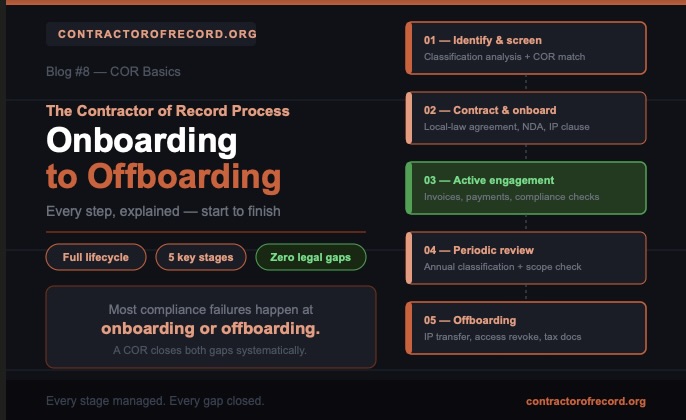
One of the most common questions businesses ask before engaging a Contractor of Record is simple: what actually happens? What does the COR do, in what order, and how does it interact with what our team is already doing?
The COR process is not complicated — but it is precise. Each stage has specific actions, specific documentation, and specific compliance checkpoints. Understanding the full lifecycle helps businesses engage a COR effectively and avoid the gaps that compliance failures typically fall into.
This post walks through every stage of the COR process, from the moment you decide to engage a contractor to the moment the engagement formally ends.
Stage 1: Identify and Classify
Before a COR can do anything, two things need to be established: who the contractor is, and whether the relationship can legitimately be structured as an independent contractor engagement.
You handle the first part. The COR handles the second.
Your business identifies the contractor — through recruiting, referrals, a talent platform, or your own network. You assess their skills, negotiate the rate, and decide you want to move forward. At this point, you bring the COR in.
The COR conducts a classification screening. This is a structured analysis of the proposed working relationship against the applicable legal standards in the contractor’s jurisdiction. The screening examines:
Whether the worker has an independent business identity — their own legal entity, their own clients, their own professional infrastructure. A contractor with no independent business profile is a higher classification risk.
Whether the work is scoped around deliverables or around ongoing presence. A contractor hired to deliver a defined feature, audit, report, or design is more defensible than one hired to “be available for whatever the team needs.”
Whether the contractor will work exclusively for your company. Exclusivity is a significant red flag in almost every classification framework.
Whether the applicable law in the contractor’s country imposes specific tests or presumptions. Germany’s Scheinselbständigkeit doctrine, the UK’s IR35 rules, California’s ABC test, Brazil’s PJ requirements — each creates specific conditions that must be met.
If the relationship passes classification screening, the COR confirms it can proceed and moves to Stage 2. If it does not pass — if the relationship looks more like employment than contracting — the COR will flag this and either recommend restructuring the engagement or suggest an EOR solution instead. A COR that agrees to proceed regardless of classification risk is not providing a compliance service; it is providing a payment processing service with compliance risk still sitting entirely with your business.
The classification screening produces a written analysis that becomes part of your compliance record. If you are ever audited, this document demonstrates that a good-faith determination was made before the engagement began.
Stage 2: Contract Execution and Onboarding
Once classification is confirmed, the COR executes the formal engagement. This stage has several components that happen in sequence.
The COR prepares and executes a jurisdiction-appropriate contractor agreement with the contractor. This is not a generic template — it is an agreement drafted or reviewed by someone with legal expertise in the contractor’s country, covering the specific requirements of that jurisdiction.
The agreement includes: a clearly scoped statement of work defining deliverables and timelines rather than ongoing duties; payment terms including rate, invoicing schedule, currency, and payment method; an intellectual property assignment clause that transfers all IP created during the engagement to your company under the law of the contractor’s jurisdiction; a non-disclosure and confidentiality provision; a statement of independent contractor status with appropriate wording under local law; governing law and dispute resolution provisions; and termination provisions specifying notice requirements and the final payment and handover process.
The COR collects the contractor’s tax documentation. In the US, this means a W-9 for domestic contractors or a W-8BEN/W-8BEN-E for foreign contractors. In the contractor’s home country, this may include GST registration details, PAN numbers, VAT registration, CNPJ, or other locally required identifiers.
The COR verifies the contractor’s business identity — confirming their registered entity, tax ID, and any professional credentials relevant to the engagement.
If a background check is required — common for contractors who will have access to sensitive systems, financial data, or client environments — the COR coordinates this as part of onboarding.
The COR sets up the payment relationship: the contractor’s banking details for payment, the preferred payment currency, and the invoicing format the contractor should use. From this point on, the contractor invoices the COR — not your company directly.
Your team receives confirmation that the contractor is formally onboarded and ready to begin work, along with the start date and any relevant documentation. The contractor is also introduced to whatever project management, communication, and access systems your team uses.
The entire onboarding process — from classification confirmation to contract execution to payment setup — typically takes 24 to 72 hours for a straightforward engagement. More complex engagements in high-risk jurisdictions may take longer due to additional documentation requirements.
Stage 3: Active Engagement
This is the core of the COR relationship — the period during which the contractor is actively working and the COR is managing the legal and financial infrastructure in the background.
From your team’s perspective, Stage 3 should be nearly invisible. You direct the work, review the output, and communicate with the contractor just as you would with any project collaborator. The COR does not participate in day-to-day project management.
Behind the scenes, the COR is managing several ongoing functions.
Invoice processing. When the contractor completes a milestone or reaches an invoicing interval, they submit an invoice to the COR. The COR reviews the invoice for compliance — correct format, required identifiers, accurate amounts — and processes it for payment. If the invoice is non-compliant, the COR returns it for correction rather than processing it as submitted. This invoice-driven payment process is structurally important: it establishes the business-to-business character of the relationship and distinguishes it from payroll.
Payment execution. The COR remits payment to the contractor in their local currency through appropriate payment infrastructure. For international contractors, this means managing currency conversion, selecting the right payment rail (SWIFT, local ACH equivalent, or other), and ensuring payment reaches the contractor on the agreed terms. The COR absorbs the operational complexity of cross-border payments — currency volatility, banking infrastructure limitations, payment timing requirements — so your finance team doesn’t have to.
Tax documentation maintenance. For each payment, the COR maintains records that support any required tax reporting — both in your jurisdiction and the contractor’s. In countries where withholding applies to certain cross-border payments, the COR manages this correctly.
Compliance monitoring. The COR monitors regulatory changes in the countries where your contractors are based — new classification rules, updated tax requirements, changes to invoicing standards — and alerts you to anything that affects your existing engagements.
Communication with your team. If a contractor raises an issue related to their engagement — a payment question, a contract query, a scope clarification — the COR handles the administrative and legal aspects while directing substantive work questions back to your team.
Stage 4: Periodic Review
For any engagement that extends beyond six months, the COR conducts a formal periodic review. For engagements extending beyond twelve months, this review is annual at minimum.
The periodic review examines the same factors that were assessed in the original classification screening: has the nature of the working relationship changed in ways that affect classification? Is the contractor still working for other clients? Has the scope shifted from deliverable-based to ongoing-duty-based? Have the applicable laws in the contractor’s jurisdiction changed?
If the review confirms that the engagement remains compliant, the COR updates the documentation and continues. If the review identifies concerns, the COR works with your team to restructure the engagement — or recommends conversion to employment if reclassification is unavoidable.
The periodic review documentation becomes part of the compliance record for the engagement. If an audit ever occurs, multiple documented reviews of a long-running contractor relationship demonstrate ongoing good-faith compliance management.
The periodic review is also an opportunity to update the contractor agreement if the scope has changed significantly — new projects, rate adjustments, or changed payment terms should be reflected in an updated agreement rather than managed informally.
Stage 5: Off-boarding
Every contractor engagement eventually ends. Offboarding is the stage that most businesses manage least carefully — and it is where compliance failures are disproportionately common.
When a contractor engagement reaches its end — whether through completion of the defined scope, mutual agreement to terminate, or notice under the termination provisions of the contract — the COR manages a structured offboarding process.
Final invoice and payment. The contractor submits a final invoice covering all outstanding work. The COR processes and pays this invoice promptly, on the agreed terms. Any disputes about final payment are managed through the COR, with the contractor agreement as the governing document.
IP confirmation and transfer. The COR confirms that all IP created during the engagement has been delivered and that the contractor has no outstanding claims to any work product. The IP assignment provisions of the contract are enforced. For significant engagements involving substantial code, design work, or other valuable IP, the COR may facilitate a more formal IP handover process.
Access revocation. The COR coordinates with your team to ensure that the contractor’s access to systems, data, credentials, communication platforms, and any physical resources has been fully revoked as of the engagement end date. This step is frequently overlooked in informal contractor terminations and creates both security and compliance risk.
Tax documentation issuance. In the US, if the contractor received $600 or more during the tax year, the COR issues or facilitates the issuance of a Form 1099-NEC. For international contractors, equivalent documentation requirements in their home country are managed. The COR maintains records of all payments made during the engagement to support accurate tax reporting.
Record retention. The COR ensures that all engagement documentation — the contract, all invoices, classification analysis, periodic review records, and payment history — is retained for the applicable record-retention period. In the US, this is generally seven years for employment tax purposes. Different retention requirements apply in other jurisdictions.
Engagement closure confirmation. The COR provides your team with a formal confirmation that the engagement has been closed — IP transferred, access revoked, final payment made, tax documentation issued. This confirmation gives your HR, legal, and finance teams a clean record of the engagement end.
How the Five Stages Work Together
The COR process is designed as a continuous compliance system, not a series of independent transactions. Each stage feeds into the next.
The classification analysis from Stage 1 informs the agreement structure in Stage 2. The agreement from Stage 2 governs the payment and invoicing process in Stage 3. The ongoing compliance monitoring in Stage 3 feeds into the periodic review in Stage 4. The periodic review identifies any issues that need to be resolved before offboarding in Stage 5. And the documentation from all five stages creates the compliance record that would defend the engagement in any audit.
This is why businesses that try to use a COR for payments only — routing contractor payments through the COR but skipping classification screening, or using generic agreements, or skipping periodic reviews — do not get the full compliance benefit. The COR’s value is the integrated process, not any individual component of it.
What Your Team’s Experience Looks Like
From the perspective of your HR, finance, and legal teams, working with a COR looks like this:
HR identifies a contractor need and works with hiring managers to define the scope. Once a contractor is selected, HR initiates the COR onboarding — typically through a platform portal — providing the contractor’s details, the scope of work, the proposed rate, and the contract start date.
The COR handles the classification screening, agreement execution, and onboarding documentation. HR receives a confirmation that the contractor is onboarded and can begin work, along with copies of the signed agreement and key documentation.
Finance receives invoices from the COR — not directly from the contractor — and processes payment to the COR on standard payment terms. The COR handles payment to the contractor. Finance’s contractor payment process is standardized regardless of country, currency, or contractor.
Legal has access to the COR’s agreement templates and classification analysis. For complex engagements, legal may review the agreement before execution. For standard engagements, the COR’s templates and analysis are sufficient.
At offboarding, HR initiates the offboarding process through the COR portal. The COR manages the final payment, IP transfer confirmation, access revocation coordination, and tax documentation, and provides a formal closure record.
The COR is designed to reduce the burden on your internal teams — not add to it. For businesses with a handful of contractors, the reduction in legal and administrative effort is meaningful. For businesses with dozens of contractors across multiple countries, the COR is the infrastructure that makes the contractor workforce manageable at all.