

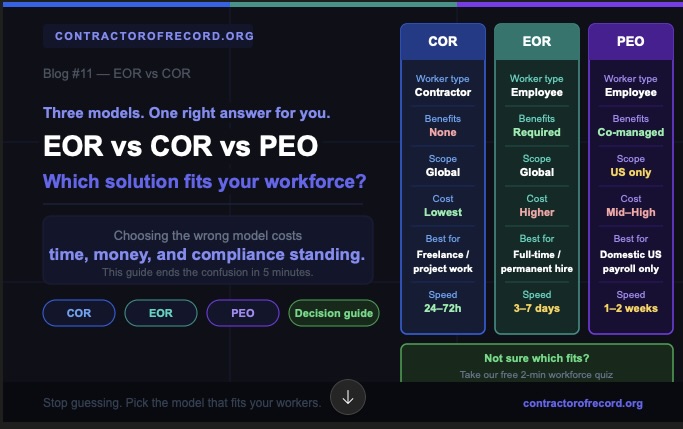
Three acronyms. Three models. One question every business with a distributed workforce has to answer: which one do you actually need?
The confusion between EOR, COR, and PEO is understandable. All three involve a third-party company managing some aspect of your workforce relationship. All three are designed to reduce the legal and administrative burden of employing or engaging workers. And all three can appear to do roughly the same thing until you look closely.
They don’t. Each model solves a specific problem for a specific type of worker in a specific context. Using the wrong model either leaves you with unmanaged compliance risk or paying for services you don’t need.
This guide cuts through the confusion with a definitive, practical comparison.
The One-Sentence Version of Each Model
A Contractor of Record (COR) manages independent contractor relationships on your behalf — compliantly, legally, and across borders.
An Employer of Record (EOR) employs full-time workers in countries where you have no legal entity, handling payroll, benefits, and employment law compliance.
A Professional Employer Organization (PEO) co-employs your domestic US workers with you, sharing HR, payroll, and benefits administration responsibilities.
That’s the core of it. Everything else is application and detail.
What Is a Contractor of Record?
A COR is the legal and compliance infrastructure for independent contractor relationships. When you engage a COR, the COR:
Signs and holds the contractor agreement on your behalf, using jurisdiction-appropriate contract language that passes local classification tests. Manages cross-border payments in the contractor’s local currency, handling invoicing, currency conversion, and any applicable withholding. Conducts worker classification screening before engagement begins to ensure the relationship can legitimately be structured as a contractor arrangement under applicable law. Manages the complete engagement lifecycle — onboarding, periodic review, offboarding — with documentation that would defend the classification in any audit.
The fundamental characteristic of a COR engagement: the worker remains an independent contractor. They are not employed by anyone. The COR provides legal structure and payment infrastructure; it does not create an employment relationship.
This is both the model’s strength and its limitation. COR works exceptionally well for genuine contractor relationships — project-based work, specialist engagements, flexible arrangements. It is not appropriate for workers who are functionally employees.
What Is an Employer of Record?
An EOR is the legal employer of your workers in countries where you don’t have a local legal entity. When you engage an EOR, the EOR:
Puts the worker on a local payroll compliant with the employment laws of their country. Withholds and remits all employment taxes — income tax, social security contributions, and any other mandatory withholdings. Administers required statutory benefits — health insurance, pension contributions, paid leave, maternity and paternity provisions, and any other legally mandated entitlements. Issues compliant employment contracts under local law, including required terms around notice periods, probationary periods, and termination procedures. Manages all employment law compliance for the jurisdiction — collective bargaining requirements, anti-discrimination obligations, work permits if applicable.
The fundamental characteristic of an EOR engagement: the worker is a genuine employee. They have full employment rights under the law of their country. The EOR is the employer on paper and in law; you retain operational direction and management of the worker’s day-to-day activities.
An EOR is typically more expensive than a COR because the legal obligations it manages — employment taxes, benefits, employment law compliance — are significantly more substantial than those involved in managing a contractor relationship.
What Is a Professional Employer Organization?
A PEO is a co-employment arrangement used primarily for domestic US workforce management. When you engage a PEO, the PEO:
Becomes a co-employer of your US employees alongside you. You retain the employer-of-record status for most purposes, but the PEO manages the employment administration. Manages payroll processing, tax withholding and remittance, and unemployment insurance contributions. Administers employee benefits — and because PEOs aggregate workers from many client companies, they can offer access to benefits plans (health insurance, retirement) that individual small businesses could not negotiate independently. Handles HR compliance — managing employee documentation, supporting performance management processes, providing HR policy templates, and helping navigate employment law requirements.
The fundamental characteristic of a PEO engagement: it is a co-employment model, not a full outsourcing model. You remain the employer for most legal purposes. The PEO shares the administrative burden without fully assuming the legal role of employer.
PEOs operate almost exclusively in the US market. They are not typically used for international hiring — that’s what EORs are for. And they work only with employees, not contractors.
The Complete Comparison
| Dimension | COR | EOR | PEO |
|---|---|---|---|
| Worker type | Independent contractor | Full-time employee | Full-time employee |
| Legal employer | COR holds contract; worker is self-employed | EOR is legal employer | Co-employment; you remain primary employer |
| Geographic scope | Global | Global (international focus) | Primarily US domestic |
| Benefits required | No | Yes — legally mandated by country | Yes — administered by PEO |
| Payroll taxes | None — contractor invoices | Full employer payroll taxes | PEO manages and remits |
| Employment protections | Minimal — contractor rights | Full — local labor law | Full — US federal and state law |
| Termination process | Low complexity — contract end | High complexity — local notice, severance | Moderate — US employment law |
| Setup speed | 24–72 hours | 3–7 business days | 1–2 weeks |
| Cost | Lowest | Higher | Mid to high |
| Primary risk managed | Worker misclassification | International employment law | Domestic HR compliance |
| Entity setup required | No | No | No |
| Compliance expertise needed | Classification law | International employment law | US employment law |
How to Choose: A Decision Framework
The choice between COR, EOR, and PEO is almost always determined by three questions. Answer them in order.
Question 1: Is the worker an independent contractor or an employee?
This is the threshold question. Everything else follows from the answer.
If the worker has their own independent business, works for multiple clients, delivers defined project outcomes rather than ongoing labor, and would pass the applicable classification tests in their jurisdiction — they are a contractor. Use a COR.
If the worker works exclusively or primarily for you, is integrated into your team and processes, has an ongoing indefinite relationship with your company, and would be classified as an employee under the applicable tests in their jurisdiction — they are an employee. Use an EOR or PEO.
If you are not sure, do the analysis formally rather than guessing. Apply the IRS Common Law Test, the DOL Economic Realities Test, and the applicable state or country test. If the worker is in a state with an ABC test, Prong B — whether the work is within your usual course of business — is usually the decisive factor.
Never choose COR simply because it is cheaper. If the working relationship is employment, using a COR does not make it a contractor relationship. It just adds a payment layer between you and an employee while your misclassification liability continues to accumulate.
Question 2: Where is the worker located?
For contractors anywhere in the world: COR.
For employees outside the US in a country where you have no legal entity: EOR.
For employees inside the US where you want to share HR administration burden: PEO.
For employees inside the US in a country where you have a legal entity: you may not need any of these models — you can employ directly through your entity and manage HR in-house or with standard payroll software.
Question 3: What is the nature and duration of the work?
Short-term, project-scoped, outcome-defined: COR is natural fit regardless of location.
Ongoing, integrated, indefinite: EOR or PEO depending on location.
A mix — some project-based contractors and some permanent employees: use both COR and EOR simultaneously, applying each to the appropriate worker type.
Combining COR and EOR: The Most Common Real-World Pattern
Many businesses assume they have to choose between COR and EOR. In practice, most companies with a distributed workforce use both simultaneously — sometimes through the same provider, sometimes through different ones.
A typical pattern for a US-based tech company at Series B scale might look like: 15 full-time employees in the US employed directly, 4 country managers in Germany, France, Singapore, and Brazil hired as genuine full-time employees through an EOR, and 18 specialist contractors in India, the Philippines, Poland, and Mexico engaged through a COR for product development, QA, and marketing work.
This isn’t complexity for its own sake. It reflects the reality that different roles require different working arrangements, and compliance infrastructure should match the actual nature of each relationship.
Common Mistakes in Model Selection
Choosing COR to save money on what is actually an EOR situation. The cost difference between COR and EOR is real — typically 30–50% less per worker. The temptation to use COR for workers who are functionally employees is understandable. The consequences — misclassification liability, retroactive tax exposure, retroactive benefits claims — routinely cost far more than the savings over the entire relationship.
Using a PEO for international workers. PEOs are designed for US domestic employment. They typically do not have the country-specific legal expertise, local payroll infrastructure, or benefits administration capabilities required for international employment. An international EOR is the appropriate tool for workers outside the US.
Assuming EOR is always necessary for international workers. A genuine independent contractor in Germany or Australia can be engaged through a COR without an EOR — provided the classification holds up under local law. EOR is required when the working relationship is genuine employment, not simply because the worker is outside the US.
Switching models mid-engagement without a formal restructuring. If a COR-managed contractor relationship drifts into employment, converting it to EOR mid-stream is possible but complex. It typically requires terminating the contractor relationship, a gap period, and a fresh employment engagement. The messier the transition, the more documentation risk. The better approach is to get the model right from the start.
A Word on Providers That Offer Both COR and EOR
Several providers in the market offer both COR and EOR services — sometimes through the same platform. This can be operationally convenient: a single vendor relationship, consistent invoicing, a unified compliance record.
The caveat: confirm that the provider genuinely applies different legal frameworks to COR and EOR engagements — not just a different label on the same payment infrastructure. A provider that “COR-manages” what are actually employee relationships is not providing compliance protection for either party; it is providing a veneer of compliance while the underlying liability remains.
When evaluating providers, ask: do they conduct classification screening before COR engagements? Do they decline to manage engagements that don’t pass classification? Do they maintain jurisdiction-specific agreements and compliance processes? These are the indicators of a genuine compliance service rather than a payment processing service with compliance branding.
Which One Does contractorofrecord.org Provide?
We specialize in Contractor of Record services — the classification screening, jurisdiction-appropriate agreements, cross-border payment infrastructure, and full engagement lifecycle management that turns international contractor hiring from a compliance liability into a compliant, scalable operation.
For clients who also need EOR services, we can connect you with trusted EOR partners who apply the same compliance rigor we do for contractor engagements. The goal is always the right model for the right worker — not the most convenient model for administrative simplicity.
Summary Decision Guide
Use COR when: you have genuine independent contractors, anywhere in the world, for project-based or flexible work.
Use EOR when: you have genuine employees outside the US in countries where you have no legal entity.
Use PEO when: you have domestic US employees and want to share HR, payroll, and benefits administration with a co-employer.
Use all three when: your workforce includes a mix of US employees, international employees, and international contractors — which describes most companies at growth stage.