

The global remote contractor market has matured significantly. What was once an exotic hiring strategy — sourcing talent from India, Eastern Europe, or Southeast Asia — is now standard operating procedure for companies of every size. The infrastructure exists. The talent is there. The tools make collaboration seamless across time zones.
What has not matured at the same pace is the compliance infrastructure most companies use to manage these relationships. A 2025 survey of companies with international contractor workforces found that fewer than 40% had jurisdiction-specific contractor agreements in place, and fewer than 25% had conducted classification screening under local law.
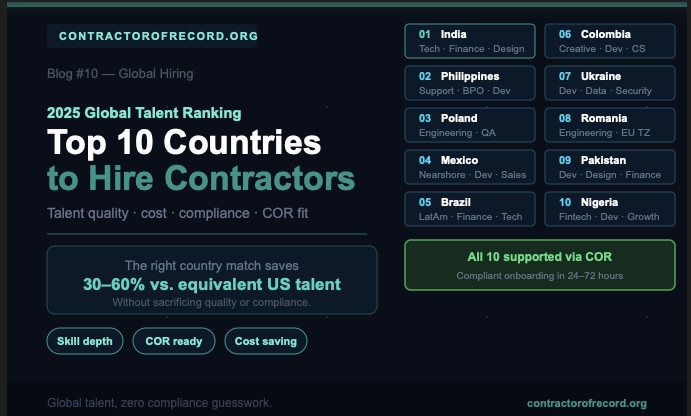
This guide ranks the top 10 countries for remote contractor talent based on skill depth, talent supply, cost, time zone alignment with major business hubs, and compliance accessibility via a Contractor of Record. For each country, we also flag the key compliance considerations that businesses need to understand before engaging.
How We Ranked These Countries
The ranking weighs five factors equally:
Talent depth — the volume of skilled professionals available for contractor engagement in high-demand categories (software development, design, finance, marketing, data, customer success).
Cost competitiveness — the average contractor rate relative to equivalent US or UK rates, expressed as a cost saving percentage.
English proficiency — the practical ability to communicate and collaborate with English-speaking teams without significant friction.
Compliance accessibility — how readily a legitimate contractor relationship can be structured and maintained under local law, and whether a COR can effectively manage the engagement.
Time zone alignment — how well the country’s working hours overlap with US East Coast, US West Coast, or Western European business hours.
1. India
India remains the undisputed leader in global contractor talent supply. With over 5 million software developers, a deep bench of finance professionals, a large pool of design and digital marketing talent, and a growing data science and AI engineering community, India offers depth across virtually every high-demand skill category.
Cost savings versus US equivalents range from 40–70% depending on the role and experience level. English proficiency is high across professional services. The Indian education system produces approximately 1.5 million STEM graduates annually, sustaining a supply pipeline that shows no signs of slowing.
Compliance considerations: India has clear GST invoicing requirements for contractors billing above the registration threshold. Payments are subject to TDS (Tax Deducted at Source) for certain categories. Classification risk is generally manageable for project-based engagements structured around deliverables, though indefinite, exclusive relationships carry risk under Indian labor law. A COR with India expertise manages GST compliance, TDS handling, and INR payments seamlessly.
Time zone: India Standard Time (UTC+5:30) has good overlap with European morning hours and US East Coast late afternoon. It requires some flexibility for real-time collaboration with US West Coast teams, but asynchronous workflows work exceptionally well.
Best for: Software development, QA, data engineering, financial analysis, technical support, content creation, and back-office functions.
2. Philippines
The Philippines has built one of the world’s strongest contractor workforces in customer support, business process outsourcing, and increasingly in software development, creative services, and digital marketing. A large English-speaking population — English is an official language — eliminates the communication friction that affects other markets.
Cost savings versus US equivalents are typically 50–65%. The Philippines has a well-established culture of remote work and contractor engagement, and contractors are generally familiar with international client relationships.
Compliance considerations: Filipino contractors typically operate as sole proprietors or through OPC (One Person Corporation) structures registered with the SEC. The Bureau of Internal Revenue (BIR) has specific invoicing and withholding requirements. A COR manages BIR compliance, proper invoicing, and PHP payments through local payment infrastructure.
Time zone: Philippine Standard Time (UTC+8) aligns well with Australian business hours and partially with US West Coast evenings. It requires deliberate scheduling for US East Coast real-time collaboration but works well for follow-the-sun operational models.
Best for: Customer support, QA, data annotation, creative design, content writing, digital marketing, virtual assistance, and increasingly mobile and web development.
3. Poland
Poland has emerged as one of Europe’s premier technology contractor hubs, with a deep engineering talent pool, strong English proficiency, and excellent alignment with Western European business hours. Polish developers are widely regarded as among the strongest in Europe, and the country has produced a significant number of successful technology companies and technical leaders.
Cost savings versus US equivalents range from 30–55%. The cost advantage is lower than Asia or Latin America but the time zone alignment, cultural proximity to Western European clients, and engineering quality make Poland highly competitive for European-market companies and US companies that want EU time zone coverage.
Compliance considerations: Poland applies a contractor classification framework under the Polish Labor Code that focuses on whether the worker is personally performing the work, is subject to management direction, and is working for a fixed time and place. Genuine project-based engagements typically pass this framework. However, long-running exclusive relationships carry reclassification risk. A COR manages compliant agreements under Polish law and PLN payments.
Time zone: Central European Time (UTC+1, UTC+2 in summer) is fully aligned with Western European business hours and has a 6-hour overlap with US East Coast mornings.
Best for: Software engineering, DevOps, cloud infrastructure, cybersecurity, data science, and technical architecture.
4. Mexico
Mexico is the premier nearshore contractor market for US-based companies. Geographic proximity, significant time zone alignment with US time zones, and a rapidly growing technology talent pool make Mexico uniquely valuable — particularly for companies that want real-time collaboration without a 10-hour time difference.
Cost savings versus US equivalents range from 30–50%. The Mexico City tech scene has grown rapidly, supported by a strong UNAM engineering program and a significant presence of major technology companies that have seeded a local talent ecosystem.
Compliance considerations: Mexican contractors typically invoice through their own RFC-registered entities with CFDI (Comprobante Fiscal Digital por Internet) compliant invoicing. IMSS (social security) implications need to be assessed for each engagement — genuine contractor relationships structured around deliverables can be maintained, but employee-like arrangements carry reclassification risk. A COR manages CFDI-compliant invoicing and MXN payments.
Time zone: Mexico City is Central Time (UTC-6), fully aligned with US Central time and within 2–3 hours of both US coasts. This makes Mexico the strongest time zone fit on this list for US-based companies.
Best for: Software development, UX/UI design, digital marketing, data analytics, nearshore sales support, and customer success.
5. Brazil
Brazil is Latin America’s largest economy and talent market, with a deep pool of technology professionals, finance specialists, and creative talent. São Paulo in particular has developed a significant fintech and startup ecosystem that has produced world-class engineering and product talent.
Cost savings versus US equivalents are typically 35–55%. Portuguese language skills are universal among Brazilian professionals, but English proficiency varies — it is strong among technology and finance professionals and more variable in other categories.
Compliance considerations: Brazil is one of the more complex contractor markets globally. The PJ (Pessoa Jurídica) contractor model is legitimate and widely used, but Brazilian labor courts apply strict scrutiny to PJ relationships through the pejotização doctrine. Indicators of employment — exclusivity, fixed hours, management direction, economic dependence — can result in reclassification with retroactive CLT benefits. A COR with Brazil expertise conducts rigorous classification screening, manages CNPJ verification, and handles BRL payments through PIX or other local rails.
Time zone: Brazil Standard Time (UTC-3) aligns well with US East Coast hours. Brasília time has a 2-hour difference from New York, making real-time collaboration straightforward.
Best for: Software development, fintech, data science, digital marketing, financial analysis, and creative services.
6. Colombia
Colombia has been one of the fastest-growing nearshore technology markets over the past five years. Medellín in particular — sometimes called the Silicon Valley of Latin America — has developed a strong engineering and design community, and Bogotá hosts a significant concentration of finance and business service professionals.
Cost savings versus US equivalents are typically 40–55%. English proficiency is improving rapidly among technology professionals, and many Colombian contractors have worked extensively with US clients.
Compliance considerations: Colombia applies a contractor classification framework that examines personal service, subordination, and economic dependence. Genuine project-based engagements can be structured as compliant contractor relationships. Retención en la fuente (withholding at source) applies to certain service payments and must be handled correctly. A COR manages Colombian contractor law compliance and COP payments.
Time zone: Colombia Standard Time (UTC-5) aligns closely with US East Coast time, making it one of the strongest time zone fits in Latin America for US companies.
Best for: Software development, UX/UI, digital marketing, data analytics, customer success, and business operations.
7. Ukraine
Despite the ongoing disruption caused by the war with Russia, Ukraine continues to be one of Europe’s strongest technology talent markets. Ukrainian developers are renowned for their technical depth — particularly in system-level programming, cybersecurity, data science, and blockchain development — and a significant portion of the talent base has relocated to EU countries while maintaining contractor availability.
Cost savings versus US equivalents range from 40–60%. English proficiency among Ukrainian technology professionals is generally high.
Compliance considerations: For contractors still in Ukraine, the standard contractor model uses individual entrepreneur (FOP) registration, which provides a legitimate structure for contractor relationships. For Ukrainian contractors who have relocated to EU countries, the compliance framework of the host country applies. A COR assesses the contractor’s current location and legal status and structures the engagement accordingly.
Time zone: Eastern European Time (UTC+2, UTC+3 in summer) aligns with Western European business hours and has a partial overlap with US East Coast mornings.
Best for: Software engineering, cybersecurity, data science, blockchain development, and systems programming.
8. Romania
Romania combines Eastern European engineering depth with EU membership — a combination that is particularly valuable for companies that want access to high-quality technical talent while maintaining compliance within the EU regulatory framework.
Cost savings versus US equivalents range from 35–50%. Romanian engineers are well-regarded for their mathematical and algorithmic ability, and the country has produced a significant number of top-tier software professionals.
Compliance considerations: Romania’s contractor framework is generally accessible for genuine project-based engagements. The key consideration is that Romanian law presumes employment for workers who work exclusively for one client and follow management direction. EU GDPR compliance is standard. A COR manages Romanian contractor law, RON payments, and any applicable EU-specific requirements.
Time zone: Eastern European Time (UTC+2) provides full alignment with Western European business hours.
Best for: Software engineering, embedded systems, data engineering, QA, and algorithm-intensive technical roles.
9. Pakistan
Pakistan has a rapidly growing technology talent pool — driven by significant government investment in technology education and a young, tech-oriented demographic — with cost competitiveness that rivals India and the Philippines.
Cost savings versus US equivalents are typically 50–70%. English proficiency is high among technology and business professionals, and Pakistan produces a significant number of engineering graduates annually.
Compliance considerations: Pakistani contractors typically operate as sole proprietors or through private limited companies. The Federal Board of Revenue (FBR) has specific invoicing and withholding requirements for service payments. A COR manages FBR compliance and PKR payments through appropriate channels.
Time zone: Pakistan Standard Time (UTC+5) is adjacent to India Standard Time, providing similar overlap characteristics with European mornings and US afternoons.
Best for: Software development, mobile development, graphic design, digital marketing, financial analysis, and data entry functions.
10. Nigeria
Nigeria is Africa’s largest technology talent market and one of the fastest-growing in the world. Lagos has developed a significant fintech ecosystem, and the country produces a growing number of software engineers, data professionals, and digital marketers. Nigerian professionals are increasingly engaged by global companies for technology, finance, and growth roles.
Cost savings versus US equivalents are typically 55–70%. English is an official language, and Nigerian professionals are generally confident English communicators.
Compliance considerations: Nigeria’s contractor framework requires careful management. The Federal Inland Revenue Service (FIRS) has withholding tax requirements for service payments, and the applicable rate depends on the nature of the services. Contractors typically operate as sole traders or through limited liability companies. A COR manages FIRS compliance and NGN or USD payments.
Time zone: West Africa Time (UTC+1) aligns perfectly with Central European Time and has a 6-hour overlap with US East Coast business hours.
Best for: Fintech, software development, data science, growth marketing, content creation, and customer-facing roles.
How to Use This Ranking
This ranking is a starting point, not a hiring mandate. The right country for a specific role depends on the specific skills required, the time zone that maximizes collaboration efficiency for your team, the cost budget, and the compliance complexity your organization is prepared to manage.
A few practical guidelines:
For maximum talent depth and cost competitiveness in technology roles, India and the Philippines are the default first choices for most US-based companies.
For nearshore time zone alignment with the US, Mexico and Colombia offer the strongest fit — real-time collaboration without unusual working hours.
For EU time zone coverage with strong engineering depth, Poland and Romania are the leading markets.
For emerging market access with high cost competitiveness, Pakistan and Nigeria offer compelling combinations of talent and savings.
For Latin American fintech or growth roles, Brazil offers depth that other markets cannot match.
Regardless of which country you hire from, the compliance infrastructure matters as much as the talent selection. A contractor engagement that is not structured compliantly under local law is a liability that accumulates with every month the relationship continues. A Contractor of Record with expertise in each of these markets is the infrastructure that makes the talent accessible without the compliance risk.
Start hiring in any of these markets: [Book a Free Global Hiring Consultation] or [Download our Country-by-Country Compliance Guide] covering all 10 markets in detail.